Ask any resident living near an airport about aircraft noise and you’ll get a very loud answer. So making aircraft quieter is important and that’s just what scientists at the German Aerospace Centre (DLR) and GE Aviation in Munich are attempting to do.
First though, they need to know what makes a noise on an aircraft and they have just succeeded in measuring the noise emitted by a turboprop aircraft on the ground and on the aircraft at the same time. Why turboprop? Well, because they are perceived as being noisier.
The primary source of noise in propeller-driven aircraft is the propeller, followed by the noise generated by the airframe and engines. Propeller noise is caused by their aerodynamic features and the motion between the propeller blades and the surrounding air.
In particular, propeller noise is made up of both a tonal and a broadband component. The tonal component, which is most likely to be perceived as a disturbance to the human ear, is due to:
- The displacement of air caused by the blade motion (thickness noise)
- The pressure field around the blades moving in the air (loading noise)
- The unsteady periodic variation of loading on the blades due to, for example, the aerodynamic interaction with surrounding structures.
Broadband noise, on the other hand, occurs as a result of turbulence in the boundary layer of the blade, and the interaction of the blade with turbulence in the air.

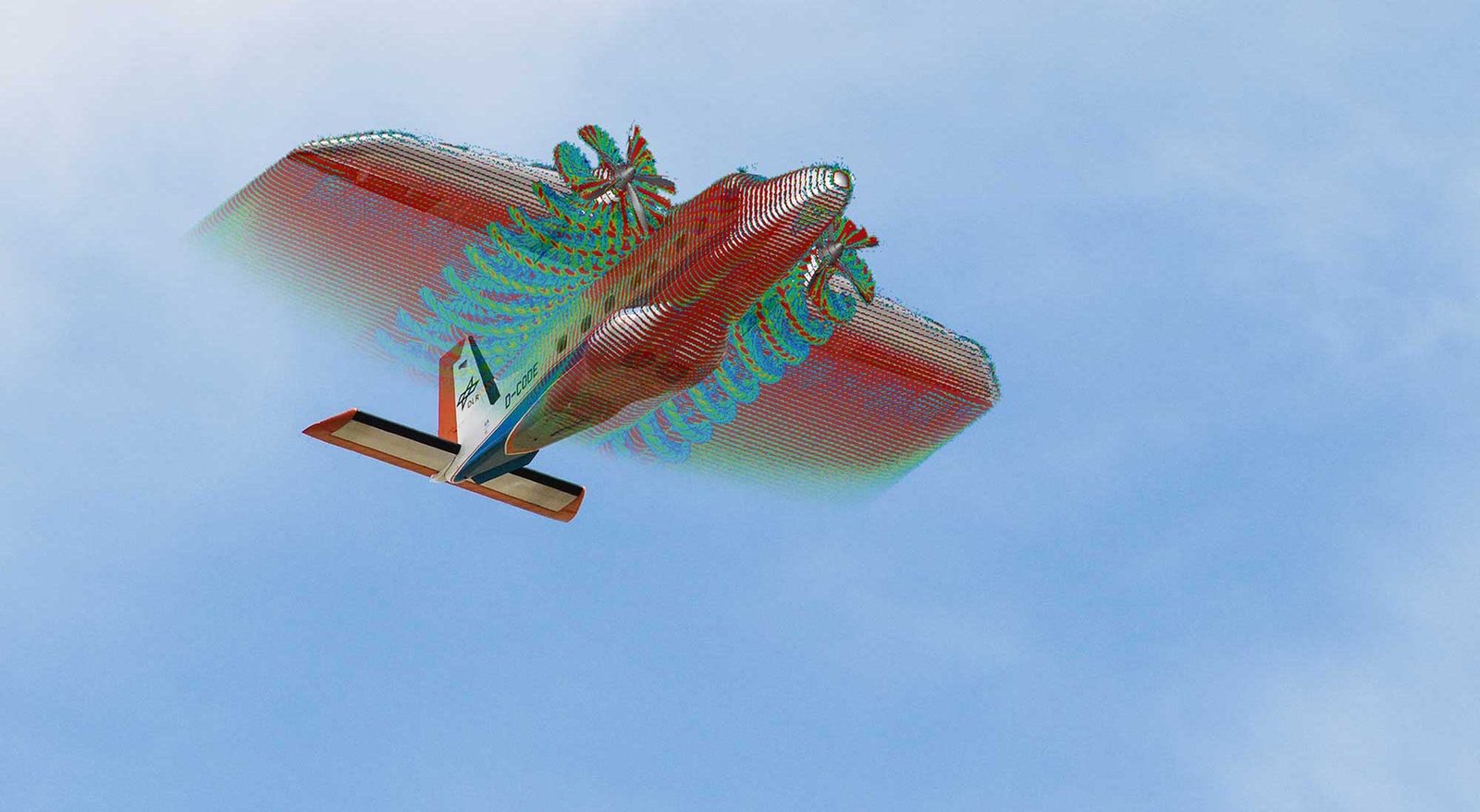
In the summer of last year, two flight tests were performed as part of the DLR/GE FusionProp project.
Both tests represented a full range of typical flight conditions including take-off, climb, cruise and approaches for landing. In addition to instrumentation on and inside the two aircraft – DLR’s DO 228 and a De Havilland Aircraft of Canada Dash 8-400 – over 200 microphones were installed on the ground at Magdeburg-Cochstedt Airport where all the flyover tests were conducted.
Noise measurements on the ground were performed with the goal of improving noise prediction methods in areas surrounding airports and to enable noise source localisation using DLR’s large microphone array. More than 50 test points were investigated in numerous flights that were conducted with flyovers above the microphones, at several heights depending on the flight condition.

The ability to accurately predict the noise levels for a variety of installations is important for future next-generation turboprop platforms.
“With the emerging introduction of hybrid and all electric propulsion solutions in the industry, attention on the propeller as the main source of noise will increase,” said Jimmy Barnard, Product Strategy and New Technology Leader at Dowty Propellers.
“Developing new technology to ensure that the lowest possible noise is produced by a particular application has been a focus of Dowty Propellers’ research for a number of years.”